Top SAP Modules List 2027: Every Major Module in Plain Words
SAP modules list 2027 in plain words: what FICO, MM, SD, PP, ABAP, Basis, SuccessFactors, Ariba and BTP do, and which module fits your background.
Top SAP Modules List 2027: Every Major Module in Plain Words
SAP modules list 2027: if you are searching for this, you probably want two things. First, a clear list of what each module actually does. Second, some idea of which one fits you. This guide covers both in plain words, without the jargon that makes most module lists hard to read.
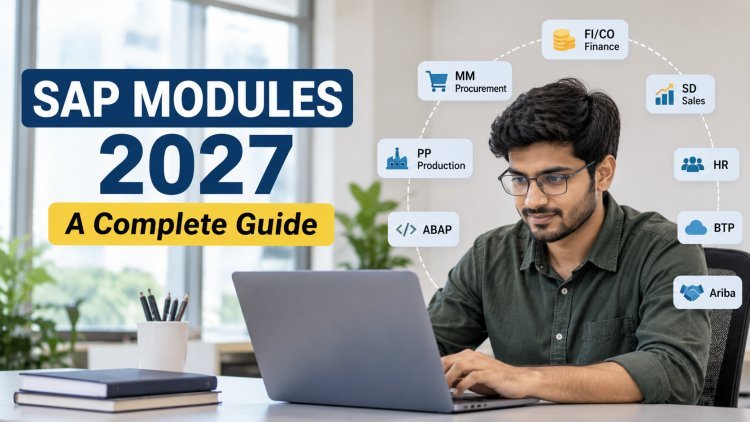
Quick answer: The major modules are FI and CO (finance and costing), MM (purchasing and stock), SD (sales and billing), PP (production), QM (quality), PM (maintenance), PS (projects), EWM (warehouse) and HCM or SuccessFactors (HR). On the cloud side, there are Ariba (procurement), IBP (planning) and BTP (the platform for apps and integration). On the technical side, there are ABAP (programming) and Basis (system administration). In S/4HANA, these modules are grouped into "lines of business" such as Finance, Sourcing and Procurement, Supply Chain and Sales.
Key takeaways
- A module is one business area inside the software, such as finance or purchasing.
- Modules fall into three families: functional (business processes), technical (code and systems) and cloud (separate products that connect to S/4HANA).
- In S/4HANA, the old module names still work in daily talk, but the system itself is organised by lines of business.
- No module is "best" for everyone. The right one follows your degree and work experience.
What is a module, in simple terms?
Think of a large company as a set of departments. Finance pays bills and closes the books. Purchasing buys raw material. Sales takes orders. HR runs payroll. Each department needs its own screens, rules and reports. A module is simply that slice of the software for one department.
The real strength is that all these slices share one database. When a sales order is saved, stock, billing and the accounts all see it. That shared flow is the reason big companies run on this software, and it is also why knowing how modules connect matters as much as knowing one module well.
In the older ECC system, everything was described by module codes like FI, MM and SD. When S/4HANA arrived, the software was regrouped into lines of business that mirror business functions. People in projects and interviews still use the module codes every day, so you need to know both sets of names.
The full SAP modules list 2027 at a glance
Here is the complete list of SAP modules in one table, covering S/4HANA, cloud and technical areas. The "Who it often suits" column is a starting point, not a rule.
| Module | Full name | What it does in plain words | Who it often suits |
|---|---|---|---|
| FI | Financial Accounting | Records every money transaction and builds the balance sheet and profit and loss | Commerce, CA, MBA Finance |
| CO | Controlling | Tracks costs and profit inside the company, by department, product or project | Cost accountants, finance staff |
| MM | Materials Management | Handles buying, vendors, stock and invoice checks | Purchase, stores, supply chain staff |
| SD | Sales and Distribution | Handles quotes, orders, delivery and billing to customers | Sales operations, order desk, billing staff |
| PP | Production Planning | Plans what to make, when and with which material | Mechanical and production engineers |
| QM | Quality Management | Manages inspections, test results and quality certificates | Quality engineers, lab staff |
| PM | Plant Maintenance | Plans repairs and servicing of machines and equipment | Maintenance engineers |
| PS | Project System | Plans and tracks budgets, timelines and costs of large projects | Project planners, construction and EPC staff |
| EWM | Extended Warehouse Management | Runs detailed warehouse work like putaway, picking and packing | Warehouse and logistics staff |
| HCM | Human Capital Management | Runs employee records, time and payroll on premise | HR and payroll staff |
| SuccessFactors | Cloud HR suite | Runs hiring, onboarding, performance, learning and core HR in the cloud | HR professionals, MBA HR |
| Ariba | Cloud procurement | Connects buyers and suppliers for sourcing, contracts and purchase orders | Procurement and sourcing staff |
| IBP | Integrated Business Planning | Forecasts demand and plans supply in the cloud | Supply chain planners |
| ABAP | Advanced Business Application Programming | The programming language used to build reports, forms and custom logic | Developers, CS and IT graduates |
| Basis | System administration | Installs, maintains, secures and tunes the system | System and database admins |
| BTP | Business Technology Platform | Builds side apps, connects systems and runs data and AI tools | Developers, integration specialists |
Functional modules explained in plain words
Functional modules cover business processes. You do not need to code for these, but you do need to understand how the business works.
Finance: FI and CO
FI is the company's official record. Every invoice, payment and journal entry ends up here, and it produces the statements that auditors and tax officers see. CO looks inward. It answers questions like "Which product line is losing money?" or "How much did the Pune plant spend on power this quarter?"
The two are usually taught and hired together as FICO. If you are from commerce, accounts or CA, SAP FICO training is often the most natural fit, because you already understand the logic behind the entries.
Logistics: MM, SD, PP, QM, PM and EWM
These modules move goods through the company. A simple way to picture them is as one chain:
- MM buys raw material from a vendor and records it in stock.
- QM checks whether the material meets the required standard.
- PP turns it into a finished product.
- EWM stores it and picks it for dispatch.
- SD sells, delivers and bills it to the customer.
- PM keeps the machines running in the background.
MM is one of the most widely used modules, because almost every company buys something. Purchase and stores staff often find an SAP MM course on S/4HANA easy to relate to, since the purchase order and goods receipt are already part of their day.
Projects: PS
PS suits companies that run long, costly projects, such as construction, power plants or shipbuilding. It breaks a project into phases, attaches budgets and tracks actual spending against the plan. It links closely with finance and purchasing.
HR: HCM and SuccessFactors
HCM is the older on-premise HR module, still used by many companies for payroll and time management. SuccessFactors is the cloud HR suite, and most new HR system work now happens there. If you come from HR, SAP SuccessFactors training is usually the more future-facing choice, while HCM knowledge stays useful wherever payroll still runs on premise.
Technical modules: ABAP, Basis and BTP
Technical modules keep the system running and extend it. They suit people from computer science, IT or networking backgrounds.
ABAP developers write the custom reports, forms, interfaces and enhancements that standard screens do not cover. The newer style, called ABAP Cloud, follows clean core rules, which means changes are built so they do not break when the system is upgraded. If you enjoy coding, ABAP developer training is the main technical entry point.
Basis administrators install systems, manage users and security, apply patches and handle performance. Every project needs them, especially during migration.
BTP is the platform where companies build side apps, connect cloud and on-premise systems, and use data and AI services. It sits next to S/4HANA rather than inside it, which is exactly why it matters more as companies move to clean core.
Which modules matter most in 2027?
The year 2027 is important because mainstream maintenance for the older ECC system ends on 31 December 2027, with optional extended maintenance until 2030. S/4HANA is supported until 2040. Many companies are still in the middle of moving, and that shapes demand in three ways.
First, core functional modules like FICO, MM, SD and PP remain in steady demand, because every migration needs people who understand these processes in both ECC and S/4HANA. Second, cloud products such as SuccessFactors, Ariba and IBP keep growing, as companies move HR, procurement and planning work to the cloud. Third, technical skills are shifting towards ABAP Cloud, BTP and integration, because clean core pushes custom work outside the main system.
AI also plays a role. Joule, the built-in AI assistant, is being added across finance, procurement and supply chain processes. It changes how people work in each module, but it still needs someone who understands the process to set it up, check its output and fix what goes wrong.
Functional or technical: which family fits you?
Use your background as the first filter. This table is a practical starting point:
| Your background | Modules to look at first |
|---|---|
| B.Com, M.Com, CA, accounts staff | FI and CO |
| Purchase, stores, supply chain | MM, then Ariba or EWM |
| Sales operations or billing | SD |
| Mechanical or production engineer | PP, QM or PM |
| HR or MBA HR | SuccessFactors, with HCM basics |
| CS, IT or BCA | ABAP or BTP |
| Networking or system admin | Basis |
If you fit two rows, pick the one where you already have work experience. Employers value a module that matches your past job, because you can explain real business situations in interviews.
Common mistakes when picking from the list
The first mistake is choosing a module only because a friend says it pays well. Pay follows experience and project work, not just the module name. The second mistake is learning only screens and transaction codes without understanding the business process behind them. The newer certification exams are practical and test what you can actually do in the system.
A third mistake is ignoring integration. A consultant who knows how MM passes an invoice to FI, or how SD updates stock, is far more useful than one who knows a single module in isolation. Finally, some learners try to study three modules at once. It is better to learn one well, practise it fully and then add a related one.
Where Zeblearn fits
Zeblearn offers live, trainer-led online training in the main functional and technical modules, with weekday and weekend batches and class recordings. Training is done on an S/4HANA system and includes certification preparation. Placement support covers resume help, mock interviews and interview referrals, though it is support and not a job guarantee.
If you are still unsure which module on this list matches your degree and experience, you can speak to a Zeblearn counsellor before choosing a batch.
Final takeaway
The SAP modules list 2027 looks long, but it becomes simple once you group it. Functional modules run business processes, technical modules build and run the system, and cloud products like SuccessFactors, Ariba and BTP extend it. Start with the family that matches your background, then pick one module, learn its process end to end and understand how it connects to the others. That is what turns a list of names into a career choice.