FICO SAP Training: Course, Syllabus, Fees and Careers
Planning FICO SAP training? See the SAP FICO syllabus, certification exams, fees to check and finance career roles before you enroll.
FICO SAP Training: Course, Syllabus, Fees and Career Paths Explained
You already understand debits, credits and month-end pressure. Maybe you have worked in Tally or Excel for a few years. Then you notice that most finance job ads now ask for SAP, and you start searching for FICO SAP training. The real question is which course will prepare you for the actual work.
This guide explains what SAP FICO covers, how a typical syllabus is structured, how official SAP certification works, what to check in fees, and where the skill can take you in India and abroad.
What SAP FICO Does Inside a Company
SAP FICO combines two connected components of SAP's ERP software: Financial Accounting (FI) and Controlling (CO).
FI records transactions that matter to people outside the company. It covers the general ledger, vendor invoices and payments, customer receipts, fixed assets, bank accounting, tax and period-end closing. The balance sheet and profit and loss statement that auditors and shareholders see come from here.
CO looks inward. It shows where costs arise and which parts of the business earn money, using cost centres, internal orders, profit centres, product costing and profitability analysis. A plant head or CFO uses CO reports to decide where to cut, invest or reprice.
Here is how the two meet in practice. A manufacturer buys steel. The materials team records the goods receipt in SAP MM, FI records the liability when the vendor invoice arrives, and CO assigns the cost to the right production cost centre. When the finished product ships through SAP SD, revenue posts in FI and the margin flows into profitability analysis. That chain is why FICO consultants spend so much time on integration.
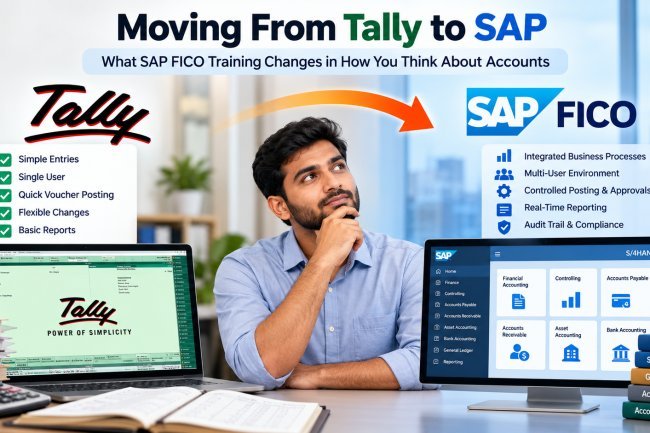
Most new implementations now run on SAP S/4HANA. There, FI and CO line items sit together in a single table known as the Universal Journal, and customers and vendors are managed as Business Partners. The core concepts carry over from older SAP ECC systems, but some screens and configuration steps differ. If that distinction is new to you, this explainer on the differences between SAP S/4HANA and SAP ECC is a useful primer.
The SAP FICO Syllabus: What You Will Actually Learn
A sound SAP FICO syllabus moves from organisational setup to daily transactions, then to controlling, reporting and integration. ZebLearn's published curriculum, for example, runs across 13 modules. The table below groups them into four stages.
|
Stage |
Main topics |
Why it matters on the job |
|---|---|---|
|
Foundations |
ERP basics, company and company code, fiscal year and posting period variants, document types, field status, tolerance groups, chart of accounts, sales and purchase tax |
Every later setting depends on this structure |
|
Core FI processes |
General ledger postings and reversals, foreign currency, accounts payable, automatic payment program, accounts receivable, dunning, asset accounting and depreciation runs |
This is the daily work of most FI support roles |
|
Controlling and reporting |
Controlling area, cost elements, cost centre accounting, distribution and assessment cycles, internal orders, profit centre accounting, CO-PA, standard financial reports |
Management reporting and cost analysis |
|
Integration |
Procure-to-pay with MM, sales process with SD, asset integration |
Most real project issues sit between modules |
Topic lists look similar across institutes, so judge a course by how it teaches them. Ask how many hours you get in a live system, whether trainers walk through real support issues, and how much of the content uses S/4HANA rather than only ECC.
Who Should Take FICO SAP Training?
This course suits people who already think in accounting terms. Commerce graduates, B.Com and M.Com holders, MBA Finance students, and CA, CMA or ACCA candidates usually find the concepts familiar. Their gap is the system, not the accounting.
It also suits accountants and finance executives who already use SAP as end users. They know the transaction codes for posting invoices but want to understand the configuration behind them. For them, FICO SAP training is often the route from operations into a functional consultant role.
A few cautions help set expectations. Someone with no accounting background will find FICO harder than modules like SD or MM. You do not need to code, since ABAP programming is a separate skill. Training alone rarely leads straight to a senior consultant job, and most learners start in support, key user or junior consultant roles.
SAP FICO Certification: How the Official Exams Work
Official SAP FICO certification is issued by SAP, not by training institutes. For SAP S/4HANA finance, two associate-level exams are most closely linked to FICO:
- SAP Certified Associate, SAP S/4HANA Cloud Private Edition, Financial Accounting (C_TS4FI): covers general ledger accounting, payables and receivables, asset accounting and financial closing.
- SAP Certified Associate, SAP S/4HANA Cloud Private Edition, Management Accounting (C_TS4CO): covers cost centre accounting, internal orders, product costing, profitability analysis and profit centre accounting.
SAP positions both as entry-level qualifications for consultants and recommends project experience alongside study. Certification is also not a one-time event. SAP asks certified professionals to keep their credential valid by completing an assessment each year.
SAP revises exam versions and formats from time to time. Before you book, confirm the current exam code, format and price on the official SAP Learning site.
Remember that a course completion certificate from an institute is different from an SAP certification. The first shows you finished structured training. The second shows you passed an SAP-proctored exam. Both can help, but recruiters treat them differently.
SAP FICO Training Fees: What the Price Should Include
SAP FICO training fees vary widely depending on the mode, duration, trainer experience, system access and placement support. Comparing only the headline number can be misleading.
At the time of writing in October 2026, ZebLearn's FICO course page lists an offer price of ₹25,000 with EMI options. The page also has a fee calculator for learners in other countries, so check it for the current figure. The SAP exam fee is separate and is paid to SAP unless a provider clearly states otherwise.
Before you pay any institute, check these points:
- Number of live instructor hours and the batch timings
- How long your SAP system access lasts
- How much S/4HANA content is included
- Whether recordings are available if you miss a class
- What placement support actually involves, such as mock interviews or referrals
- The refund policy
Career Paths After SAP Finance Training
SAP finance training opens a few clear entry points. Common roles include SAP FI consultant, SAP CO consultant, FICO support or AMS consultant, SAP finance key user, and finance analyst in an organisation that runs SAP.
In India, these roles sit in IT services and consulting firms, Global Capability Centres, and large manufacturers, banks and retailers. Internationally, SAP finance skills are used across Europe, the Middle East, North America and Asia-Pacific, wherever large companies run SAP.
A typical path runs from end user or support work to junior consultant, then implementation consultant, and later to solution architect or finance lead. Pay depends heavily on experience, city and S/4HANA exposure. For realistic figures, see ZebLearn's module-wise SAP consultant salary guide.
Once you are comfortable with FICO, a natural next step is SAP S/4HANA Finance training, since many companies are moving to S/4HANA.
Mistakes to Avoid and How ZebLearn Can Help
Learners often lose time in predictable ways. Some chase a certificate without enough system practice and then struggle in interviews that ask how they would fix a failed payment run. Others skip CO because FI feels more familiar, even though many projects need both. Learning only ECC screens is another trap when most new work happens on S/4HANA.
The SAP FICO course at ZebLearn is built around these practical needs. According to the course page, it offers live instructor-led SAP FICO online training in weekday and weekend batches, access to an SAP S/4HANA sandbox, weekly quizzes and a capstone exercise that simulates a month-end close. After the course, learners get lifetime LMS access with recordings, mock interviews, and resume and placement assistance.
If you are weighing your options, start by reading the full module list on the course page and comparing it with your current skills. Then book a free demo class or speak with a ZebLearn counsellor about batch timings and fees. Good FICO SAP training should leave you able to configure, post and explain finance processes in a live system, and that is the standard worth holding any course to.
Question: What is FICO SAP training?
Answer: It teaches you to configure and use SAP's Financial Accounting (FI) and Controlling (CO) components, from general ledger setup to cost centre reporting.
Question: Can a non-commerce graduate learn SAP FICO?
Answer: Yes, but it is harder. Learn basic accounting first, since an SAP FICO course assumes you understand ledgers, payables and receivables.
Question: Do I need coding skills for SAP FICO?
Answer: No. FICO is a functional module. Coding in SAP is done in ABAP, which is a separate skill.
Question: What is the difference between SAP FI and SAP CO?
Answer: FI records financial transactions for external reporting. CO tracks costs and profitability for internal management decisions.
Question: Which SAP certification is best for FICO?
Answer: Most learners start with SAP's S/4HANA Financial Accounting associate exam (C_TS4FI). The Management Accounting exam (C_TS4CO) covers the CO side.
Question: Is the ZebLearn certificate the same as SAP certification?
Answer: No. ZebLearn's certificate confirms you completed its training. Official SAP certification requires passing an SAP-proctored exam.
Question: How much are SAP FICO training fees at ZebLearn?
Answer: In October 2026, ZebLearn's course page listed an offer price of ₹25,000 with EMI options. Check the page for the current fee.
Question: Is SAP FICO still relevant with SAP S/4HANA?
Answer: Yes. S/4HANA keeps the FI and CO concepts but changes some data structures and screens, so choose training with S/4HANA coverage.
Question: What jobs can I get after SAP FICO training?
Answer: Common entry roles include FICO support consultant, SAP finance key user, junior FI or CO consultant, and finance analyst in an SAP-using company.