Is SAP Worth Learning in 2027? An Honest Answer by Stage
Is SAP worth learning in 2027? An honest answer for freshers, working professionals and ECC consultants, with who should start now and who should wait.

Quick answer: Is SAP worth learning in 2027? For most people with a matching background, yes. Companies are still moving from the old ECC system to S/4HANA, many will keep doing so until 2030, and the newer system is supported until 2040. But it is not worth it for everyone. Your stage, your background and your willingness to practise decide the answer.
Key takeaways
- Mainstream support for the old ECC system ends on 31 December 2027, with paid support until 2030 and S/4HANA backed until 2040.
- Analyst and user-group research shows a large share of companies have still not finished moving, so migration work continues for years.
- India holds a big share of SAP’s own research and development, and a large share of global SAP project delivery.
- It is clearly worth it for working accountants, HR, purchase and IT staff, and for SAP end users. For freshers it depends on the module fit. For people with no interest in business processes, it is not the right choice.
What does “worth learning” really mean here?
When people ask me “is SAP worth learning in 2027?”, they usually mean three things at once: will there be jobs, will I be able to learn it, and will the money and time pay back? So this guide judges “worth it” on all three: demand, fit and return.
In counselling conversations on this question, I have never seen the answer come out the same for two people. A CA with five years in audit and a fresh B.Tech graduate are in completely different positions, even if they join the same batch. That is why the honest answer has to go stage by stage.
Is SAP still in demand going into 2027?
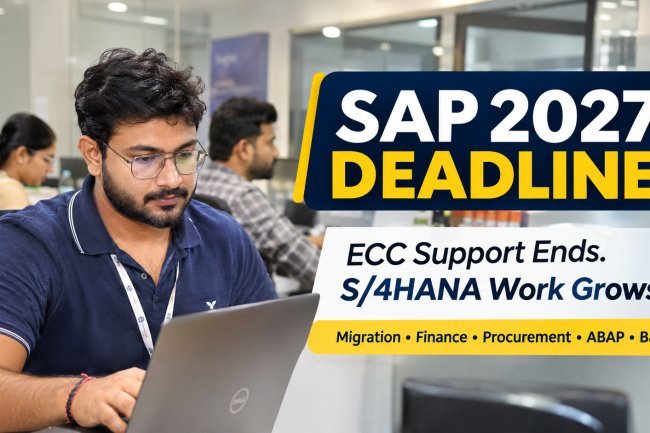
Yes. The strongest proof is how much migration work is still left. The vendor has said mainstream maintenance for its older ERP system ends on 31 December 2027, with optional paid maintenance until the end of 2030. It has committed to maintain S/4HANA until 2040.
Now look at how far companies have actually moved:
| What the research says | Who said it | What it means for you |
|---|---|---|
| At the end of 2024, only about 39% of roughly 35,000 ECC customers worldwide had licensed S/4HANA | Gartner | Thousands of companies still had their move ahead of them |
| Gartner projects that more than a third of ECC customers may still be on the old system in 2030 | Gartner | Migration and support work continues well past 2027 |
| 67% of surveyed members are fully or partially on S/4HANA in 2026, up from 50% in 2024 | ASUG (Americas’ SAP Users’ Group) with Precisely, November 2026 | Migration is speeding up, which means projects are active now |
| 49% of German-speaking ECC users plan to extend maintenance and finish moving by 2030 | DSAG investment survey, 2026 | Many large companies will be mid-project in 2027 and beyond |
| Handling old ECC customisations is the top migration challenge for 53% of respondents | ASUG with Precisely, November 2026 | Skilled people are needed to untangle and rebuild that work |
Put simply, the deadline does not end SAP work. It spreads it out over several years, and every company that moves needs finance, supply chain, HR and technical people who understand both the old and new ways of working.
Why India matters in this picture
India is not a side market for SAP. SAP Labs India is the company’s largest research and development hub outside Germany, and SAP has said about 40% of its global R&D workforce sits in India. On top of that, a large share of SAP implementation and support work for global clients is delivered by consulting firms and capability centres in Indian cities such as Bengaluru, Hyderabad, Pune, Chennai, Noida and Gurugram. This is a big reason why SAP course demand in 2027 in India remains strong.
Does SAP have a future scope after 2027?
Yes, but the work changes shape. After the migration wave, companies move into a long phase of support, upgrades, cloud moves and improvements. The newer system gets regular releases, so someone has to test, adjust and train users every year.
Two big shifts are worth knowing about:
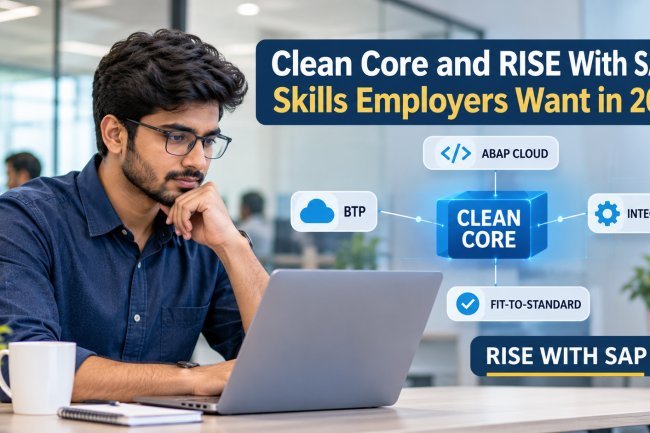
- Cloud and clean core. Companies are told to keep S/4HANA close to standard and build extra features on SAP’s Business Technology Platform. That raises demand for cloud, integration and modern development skills.
- AI inside the system. The company is adding its AI assistant, Joule, and AI agents into its products. The World Economic Forum’s Future of Jobs Report 2025 lists AI and big data, networks and cybersecurity, and technological literacy as the fastest-growing skills to 2030, and lists data entry clerks among the fastest-declining roles. For SAP learners, the message is clear: learn the process and the system well, not just the screens.
So the future scope is real, but it favours people who understand business processes and can work with newer tools.
Is SAP worth learning in 2027? The answer by stage
Here is the honest verdict for each type of learner I meet. Find your row first, then read the section below it.
| Your stage | Verdict | Why | A good module to look at first |
|---|---|---|---|
| Working accountant, CA or CMA | Strong yes | Your accounting is the hard part; you only add the system | SAP FICO training |
| Purchase, stores or supply chain staff | Strong yes | Purchasing and stock carry straight over | Our SAP MM course on S/4HANA |
| HR, payroll or recruitment staff | Yes | Cloud HR is where new HR work is going | SAP SuccessFactors training |
| Developer or IT graduate who enjoys coding | Yes | Custom code must be fixed in every migration | SAP ABAP training |
| IT support or system admin | Yes | Migrations and cloud moves need technical operations | Our SAP Basis course |
| SAP end user who wants to grow | Strong yes | You already have system experience; training adds depth | The module you already use |
| Experienced ECC consultant | Yes, but upskill now | Old-system skills alone will lose value after 2027 | S/4HANA and cloud topics in your module, plus SAP BTP training |
| Fresher with a matching degree | Yes, with a practice plan | Entry roles exist, but competition is real | The module closest to your degree |
| Career changer from an unrelated field | It depends | Possible, but you must build business basics first | Decide after a counselling call |
| No interest in business processes | Not worth it | The work is process-heavy every day | Look at other fields |
Working professionals: the best return
If you already work in accounts, purchasing, stores, production or HR, learning SAP is usually the best-value move on this list. You know the business process. The course teaches you how that process runs inside the system, which is exactly what employers ask about.
Engineers from production or plant roles often do well with SAP PP training, because planning and production orders match their daily work. Those from quality or lab roles may find SAP QM training an even closer fit.
SAP end users: worth it, and often inside the same company
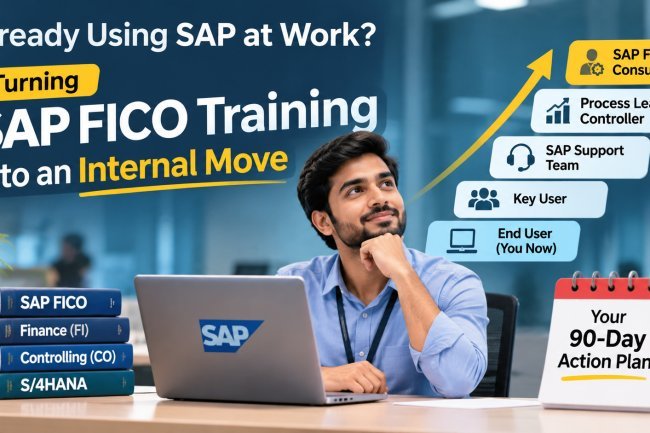
End users already have what most learners lack: daily time in a live system. Training adds the “why” behind the screens, and that is usually what turns an end user into a key user, the person who tests changes and helps colleagues. Many of these moves happen inside the same company, without a job switch.
Experienced ECC consultants: worth it only if you upskill
This is the stage where I am most direct. If your experience is mainly on the old system, SAP is still worth it for you, but only if you move your skills to S/4HANA, clean core thinking and cloud tools soon. Companies leaving ECC want people who know where they are going, not just where they have been.
HR consultants on the old system should look at the cloud path through SuccessFactors, while an SAP HCM course still helps those supporting companies that keep on-premise HR.
Is SAP worth it for freshers?
For freshers, the answer to is SAP worth learning in 2027 depends on two things: the module matches your degree, and you are ready to practise. A commerce graduate learning FICO, or an MBA in operations learning MM, has a natural story to tell in interviews. Procurement-minded freshers can also look at SAP Ariba training, since buying is moving to the cloud.
What I tell freshers plainly: your first role is likely to be an end-user, support or junior role, not a full consultant post. That is normal, and it is the right way in.
Career changers: it depends
If you come from a completely different field, SAP can still work, but plan for a longer path. You need business basics before the system makes sense. A counselling call to test your fit is worth more than jumping into a course.
When SAP is not worth learning for you
Being honest about this saves people money and time. SAP is probably not worth it for you right now if:
- you dislike structured business processes such as accounts, purchasing or payroll
- you want quick money and are not ready to practise for several months
- you are choosing a module only because someone said it pays the most
- you cannot spend regular time on hands-on practice in a live system
- you expect a course to guarantee a job; training helps, but interviews and practice decide the outcome
None of these is permanent. But if two or more apply to you today, sort them out before you pay for a course.
How to decide this month: a simple checklist
Answer these five questions honestly:
- Does my degree or job connect to finance, supply chain, production, HR or IT?
- Can I give six to eight hours a week to learning and practice for the next few months?
- Am I comfortable starting in an end-user, support or junior role?
- Do I enjoy understanding how a business process works from start to end?
- Have I picked a module because it fits me, not only because it is popular?
If you answered yes to four or five, SAP is very likely worth it for you. Two or three means it can work with the right module and more preparation. One or none means look at other options first.
Is SAP a good career in India for the long run?
For people who keep learning, yes. The SAP world rewards depth: someone who knows one module very well, understands how it connects to others and keeps up with S/4HANA and cloud changes stays useful for many years. The people who struggle are those who learn once and stop.
Think of it like learning to drive in a city that keeps building new roads. The basics stay the same, but you have to keep learning the new routes.
How Zeblearn helps you make this decision
At Zeblearn, SAP courses run as live, trainer-led online classes with recordings, with a weekday morning batch and a weekend batch, so working people can learn without leaving their jobs. You practise in an SAP S/4HANA system, the version companies are moving to. Placement support covers resume and LinkedIn help, mock interviews and interview referrals. It is support, not a job guarantee.
Before anyone enrols, a counsellor can look at your stage and background and tell you honestly whether SAP is worth it for you, and which module fits.
Your next step
So, is SAP worth learning in 2027? For working professionals, end users and freshers with a matching module, the evidence says yes: migration work runs well past the deadline, India is central to global SAP work, and the newer system is supported until 2040. For people with no interest in business processes, or no time to practise, it is better to wait or choose another path.
Find your row in the stage table, run the five-question checklist and note your answer. If you want an honest second opinion on your situation, you can talk to a Zeblearn counsellor before you decide.