SAP FICO Training for MBA Finance: Consulting or Corporate?
MBA finance fresher? See how SAP FICO training leads to consulting or corporate finance, and which track suits your personality and career goal.
SAP FICO Training for MBA Finance Freshers: Consulting Track or Corporate Finance Track?
You have an MBA in finance, campus placements are close or already over, and someone has told you to take SAP FICO training. The harder question is what comes after it. SAP FICO can lead to two quite different careers: consulting, where you work as an SAP FICO consultant who sets up and supports SAP for companies, or corporate finance, where you use SAP every day inside a finance team.
Both are good paths, and neither is “better”. The right one depends on how you like to work and what you want your career to look like in five years. This guide helps you match the track to your personality, and it also tells you when SAP FICO may not be the right spend at all.
What SAP FICO means for an MBA finance graduate
SAP is business software that many large companies use to run finance, buying, sales, production and HR in one connected system. FICO is its finance part. FI (Financial Accounting) records the books: general ledger, vendors, customers, assets and closing. CO (Controlling) tracks internal costs and profit, such as cost centres, profit centres and product costing.
Your MBA already covers the theory behind most of this. You have studied financial statements, cost accounting and budgeting. Hands-on SAP FICO training with live S/4HANA practice shows you how a real company records and reports those numbers in a live system, and that practical layer is often what MBA freshers are missing in interviews.
The two tracks, side by side
The simplest way to see the difference is this: consultants build and fix the system, and corporate finance professionals use it to run the business.
| Consulting track | Corporate finance track | |
|---|---|---|
| Where you work | SAP consulting firms, IT services companies or SAP support teams | The finance team of a company that runs SAP |
| What you do | Set up SAP for a business, test it, fix issues, train users | Close the books, track costs, build budgets, explain results |
| Who you work with | Clients, other SAP consultants, technical teams | Finance managers, business heads, auditors |
| Pace | Project-based, with busy periods before a system goes live | Monthly and yearly cycles, such as month-end and budget season |
| Skills that grow | System setup, integration, problem solving, documentation | Analysis, reporting, business sense, presenting numbers |
| Common first roles | Trainee or associate SAP FICO consultant, SAP support analyst | Finance executive, cost analyst, FP&A or controlling roles |
FP&A stands for financial planning and analysis, the team that builds budgets and forecasts.
Which track suits your personality?
Answer these six questions quickly, without thinking too long. Note whether you lean towards A or B.
- Would you rather fix a broken process (A) or explain why profit fell this quarter (B)?
- Do you enjoy learning how software works behind the screen (A), or do you mostly care about what the numbers say (B)?
- Are you comfortable switching between different clients and industries (A), or would you rather go deep into one business (B)?
- Does a tight project deadline excite you (A), or do you prefer a steady monthly rhythm (B)?
- Do you like writing step-by-step documents and test cases (A), or building reports and presentations for managers (B)?
- In five years, do you see yourself as a system expert (A) or as a finance manager (B)?
Mostly A points to the consulting track. Mostly B points to corporate finance. A close split is common, and it is a useful signal too, which the last section covers.
What the consulting track feels like
Consultants spend their days turning business needs into system settings. A client says, “we want vendor payments approved in two levels”, and the consultant works out how to set that up in SAP, tests it and explains it to users.
This suits people who enjoy detail, like solving puzzles and do not mind being the person others call when something breaks. It can be demanding near a go-live, which is the date a new system starts running live. The upside is that you learn several businesses quickly and build skills that move with you from project to project.
What the corporate finance track feels like
In corporate finance, SAP is your daily tool, not your product. You pull cost centre reports, check why a plant spent more than its budget, close the month on time and present results to managers.
This suits people who like business discussions, enjoy finding the story inside numbers and want to grow towards roles like finance manager or controller. Your MBA counts for more here, because the work leans on analysis and business judgment as much as on SAP.
How SAP FICO training should differ for each track
The same course serves both paths, but you should pay attention to different parts of it.
If you lean towards consulting, focus on configuration, which means the settings that decide how SAP behaves for a company. Practise setting up a company code, the chart of accounts, payment terms and tax codes. Learn how FI links to buying and sales, because integration questions come up often in SAP FICO consultant interviews. The SAP MM course for procurement and inventory is worth a look later if you want to deepen that link. SAP FICO certification also carries more weight on this track, since consulting firms often use it as an early filter.
If you lean towards corporate finance, spend more time on CO and reporting. Product costing, cost centre planning, profit centre reports and the month-end close are what you will use in the job. Certification helps, but your ability to read reports and explain numbers matters more.
Whichever side you pick, practise in a live system rather than only watching videos. SAP FICO training at ZebLearn runs as live, trainer-led online classes over 8 weeks with 2-hour sessions, hands-on practice in an SAP S/4HANA system and weekday or weekend batches. S/4HANA is the current version of SAP that most new projects use. For a deeper look at finance in the newer system, you can also compare the SAP S/4HANA Finance course.
On certification, SAP offers the Financial Accounting exam (C_TS4FI), which is 3 hours long with a 60% pass score, and the Management Accounting exam (C_TS4CO), with a 59% pass score. Consulting aspirants often start with FI. Corporate finance aspirants may find CO closer to their daily work.
Two MBA freshers, two different answers
Consider an MBA graduate who loved case competitions, built detailed Excel models and enjoyed presenting to faculty panels. Technical setup bores her, but a variance report gets her attention. For her, the corporate finance track fits better. SAP FICO training makes her more useful to a finance team on day one, especially in CO and reporting.
Now take a classmate who spent his MBA fixing everyone’s spreadsheets and asking how the college ERP worked. He enjoys tracing a problem to its root cause. The consulting track suits him, and he should treat configuration and integration as the core of his learning.
When SAP FICO is not the right step yet
Here is the honest part. If your goal is investment banking, equity research or corporate finance roles in firms that do not use SAP, SAP FICO training is not where your time pays off most. Valuation, modelling and markets knowledge matter more for those roles.
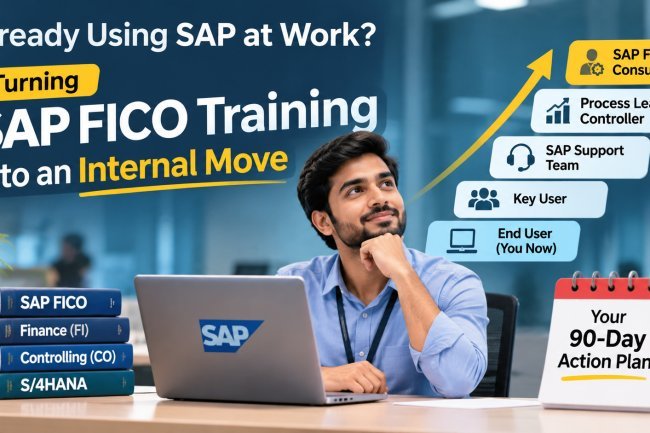
Also, if you scored close to even on the self-test, you do not have to choose today. Starting in corporate finance and becoming a key user, the finance team member who knows SAP best and works with consultants on changes, is a common way into consulting later. Moving from consulting into a corporate finance role is also possible. Your first job is a starting point, not a final decision.
Remember too that training opens doors but does not walk you through them. ZebLearn offers placement support with resume and LinkedIn help, mock interviews and interview referrals, but it is support, not a job guarantee. Your interviews and practice still decide the outcome.
Your next step with SAP FICO training
Take the six-question test again tomorrow and see whether your answers hold. Then pick the part of SAP FICO training that matches your track: configuration and integration for consulting, CO and reporting for corporate finance. A clear direction will also make your resume and interview answers sharper.
If you want help matching the course to your goal, you can speak with a ZebLearn counsellor about which track suits your profile.
Question: Is SAP FICO training useful for MBA finance freshers?
Answer: Yes, if you want to work in SAP consulting or in a finance team of a company that runs SAP. It adds practical system skills to your MBA theory.
Question: Can an MBA finance fresher become an SAP FICO consultant?
Answer: Yes, but most freshers start as trainee consultants or in SAP support roles. Strong configuration practice and integration knowledge help in interviews.
Question: What is the difference between the SAP consulting track and the corporate finance track?
Answer: Consultants set up and fix SAP for companies. Corporate finance professionals use SAP daily to close books, track costs and explain results.
Question: Which SAP certification should an MBA finance fresher take first?
Answer: Consulting aspirants often start with Financial Accounting (C_TS4FI). Those heading to corporate finance may find Management Accounting (C_TS4CO) closer to their work.
Question: Is SAP FICO useful for investment banking or equity research?
Answer: Not much. Those roles depend more on valuation, financial modelling and markets knowledge than on SAP skills.
Question: Can I switch from corporate finance to SAP consulting later?
Answer: Yes. Many people become key users in their finance team first, work with consultants on system changes and then move into consulting.