SAP vs MBA in 2027: Which Is Better for Your Career?
SAP vs MBA in 2027: compare cost, time, job roles and growth, and see when SAP is the smarter step, when an MBA is, and when both together make sense.

SAP vs MBA in 2027: Which Is Better for Your Career?
SAP vs MBA is one of the most common questions from Indian graduates deciding their next step, and the honest answer is that they are not really rivals. An MBA builds broad business and management ability over two years. SAP training builds a specific, job-ready system skill in a few months. Which is better depends on the career you want, the time and money you can spend, and the stage you are at today.
For many people, the strongest answer is not "one or the other" but "which one first". This guide compares both side by side, shows who should pick which, and explains when combining them makes the most sense.
SAP vs MBA: a quick comparison
Before going deeper, here is how the two paths compare on the points most people care about:
| Point | MBA | SAP training |
|---|---|---|
| What it is | A degree in business and management | Training in one module of SAP's business software |
| Typical duration | Two years full-time (one year for some executive programmes) | About two to three months for one module, plus practice |
| Cost in India | Varies widely; top IIMs charge roughly ₹17 lakh to ₹27.5 lakh for the two-year programme | A small fraction of a full-time MBA, though the cost varies by institute |
| Entry route | Entrance exams such as CAT, GMAT or state tests | No entrance exam; a matching background helps |
| First roles | Management trainee, analyst, associate roles | End user, support analyst, junior consultant |
| What it builds | Strategy, leadership, finance, marketing and people skills | Hands-on skill in a business process inside SAP |
| Biggest risk | High cost and two years away from work | Limited value if you never practise or get a first SAP role |
Both can lead to good careers. They simply answer different questions. An MBA answers "how do I grow into management?" SAP answers "how do I get a specific, in-demand skill quickly?"
What an MBA gives you in 2027
An MBA gives you breadth. You study finance, marketing, operations, strategy and people management, and you build a network that can matter for years. For people aiming at management, consulting at a strategy level, or leadership roles, that breadth is the main reason to do it.
Employers still value business school graduates. The Graduate Management Admission Council's 2026 Corporate Recruiters Survey, based on responses from 621 recruiters and hiring managers in 39 countries, found that most recruiters at large companies planned to hire business school graduates in 2026. The same survey also showed that technology, AI and data analysis skills saw the largest increases in importance, and that some employers have started replacing entry-level roles with AI.
That last point matters. In 2027, an MBA on its own is less of a guaranteed ticket than it once was. Graduates who pair management knowledge with a practical technology skill tend to stand out more.
The cost is the other big factor. Two years of fees, living costs and lost salary is a serious investment, especially if it is funded by an education loan. Fees at top IIMs for the 2025-27 batch range from around ₹17 lakh to ₹27.5 lakh. Many other colleges charge less, but their placement records vary widely. Always weigh the college, not just the degree.
What SAP gives you in 2027
This kind of training gives you depth in one area. You learn how a real business process, such as finance, purchasing, production or HR, runs inside the software that a large share of big companies use. It is practical, specific and quick to apply.
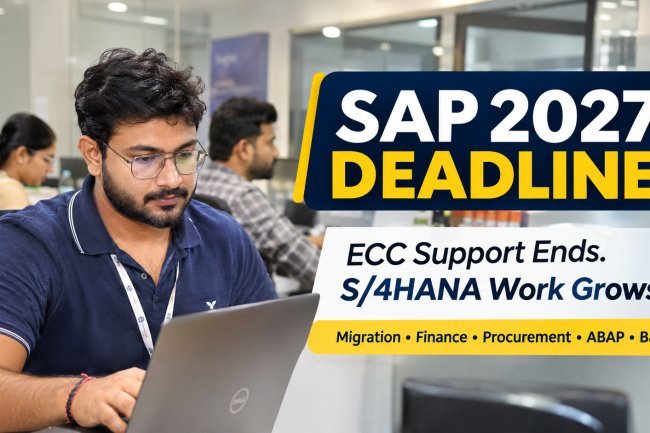
The timing also helps. SAP's older ECC system loses mainstream maintenance at the end of 2027, with paid extended support until 2030, while S/4HANA is supported until 2040. Many companies are still moving systems, and they need trained people for migration, testing and support.
It also has limits. It is a skill, not a degree. On its own, it rarely leads straight into senior management. Most people start in end-user, support or junior consultant roles and grow through project experience. The newer certification exams are practical and test what you can actually do in the system, so hands-on practice matters far more than a certificate alone.
Is SAP better than MBA? It depends on your goal
Instead of asking which is better in general, ask which fits your goal. Here is a simple way to decide:
| Your main goal | Better first choice | Why |
|---|---|---|
| Move into management or leadership roles | MBA | It builds broad business and people skills and a network |
| Get a job-ready skill quickly without leaving work | SAP | It takes months, not years, and you can learn while working |
| Become an SAP consultant | SAP | Consulting firms hire for system skill and project experience |
| Switch from a non-business field into business | MBA, then SAP | The MBA gives the business base; SAP adds a practical skill |
| You already have an MBA and want better job options | SAP | It turns broad knowledge into a specific, in-demand skill |
| Limited budget and no time for two years of study | SAP | Lower cost and shorter timeline |
If your answer points to the software path, the next step is choosing the right module, which depends on your background.
When SAP and an MBA work best together
For many people, the best answer to SAP vs MBA is to use both, in the right order. Taking an SAP course after MBA is a common route for exactly this reason. An MBA explains why a business works the way it does. SAP shows how that business actually runs day to day in a system. Together, they make you useful to both managers and project teams.
The most natural pairings follow the MBA specialisation:
- MBA Finance + SAP FICO. Finance graduates already understand financial statements and costing. Adding SAP FICO training shows how those numbers are recorded and reported in a live system, which helps in both corporate finance and SAP consulting roles.
- MBA Operations or Supply Chain + SAP MM. Purchasing, inventory and vendor management are core to operations. An SAP MM course on S/4HANA turns that knowledge into hands-on procurement skill.
- MBA HR + SAP SuccessFactors. Most new HR system work is happening in the cloud, and SAP SuccessFactors training fits HR graduates who want to work on HR technology and processes.
Picture an MBA Finance fresher who struggles in interviews because every answer is theory. After learning FICO and practising a full month-end close in a system, she can explain how revenue and costs actually flow through a company's books. That practical layer is often what makes the MBA useful in an interview.
Cost and time: an honest look at the return
The real cost of an MBA is not just the fee. It is also two years without a salary for most full-time students. That makes it a strong investment when the college and placement record are good, and a risky one when they are not.
Module training costs much less and takes a few months, so the financial risk is smaller. But the return depends entirely on whether you practise and land a first SAP role. A course you finish but never use gives very little back.
A practical way to think about it:
- If money and time are tight, SAP is usually the safer first step.
- If you can get into a well-placed MBA programme, it can be worth the investment for management-track careers.
- If you already have an MBA, adding one module is a low-cost way to make your degree more job-ready.
Who should choose which
Choose an MBA first if you want a management career, enjoy strategy and people work, can afford two years of study, and can get into a reputed programme.
Choose SAP first if you want a practical skill quickly, are already working and cannot leave your job, come from commerce, engineering or IT, or want to become an SAP consultant.
Choose both, in order, if you are an MBA graduate whose degree feels too theoretical, or a working professional who plans an executive MBA later and wants a skill now.
Common mistakes when deciding
- Choosing an MBA only because friends are doing it, without checking the college's placement record.
- Choosing SAP only because someone said it pays well, without matching the module to your background.
- Expecting either path to guarantee a job. Both need effort, practice and good interviews.
- Ignoring the order. Starting the wrong one first can cost time and money.
Where Zeblearn fits
Zeblearn runs its courses as live, trainer-led online classes with recordings, with weekday and weekend batches, so working professionals and MBA students can learn without pausing their studies or jobs. You practise in an SAP S/4HANA system, and courses include certification preparation. Placement support covers resume and LinkedIn help, mock interviews and interview referrals. It is support, not a job guarantee.
If you are unsure whether SAP, an MBA or both fits your plans, you can talk to a Zeblearn counsellor about your background and goals before deciding.
Final takeaway
SAP vs MBA is not a contest with one winner. An MBA is the better choice for a long-term management path when you can afford the time and a good college. SAP is the better choice for a fast, practical, job-ready skill, especially if you are already working. For many people in 2027, the strongest career comes from both: management understanding from an MBA and hands-on system skill from SAP. Decide by your goal, your budget and your stage, and then pick the right order.