SAP FICO Training for End Users: Grow in Your Own Company
Already an SAP end user? Learn how to use SAP FICO training to move into a key user or SAP support role inside your company, with a 90-day plan
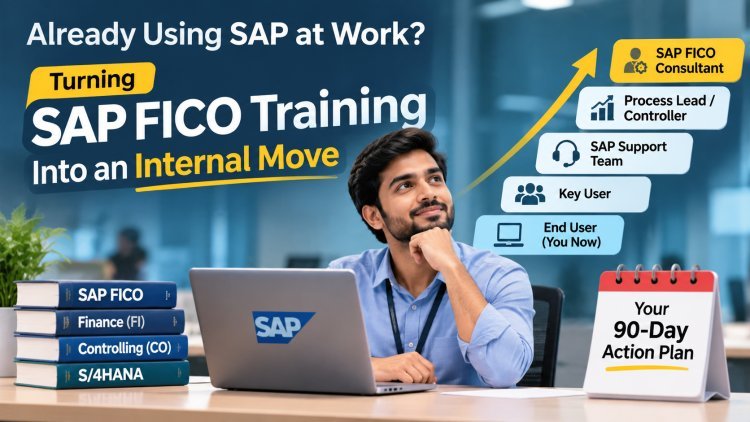
Already Using SAP at Work? Turning SAP FICO Training Into an Internal Move
You already post entries in SAP every day, you know your screens well, and yet your role has not moved in years. SAP FICO training can change that without a job switch, because the fastest way up for an SAP end user is often inside the company you already work for. The catch is that the course alone will not do it. How you use what you learn at work is what gets you noticed.
This guide shows which internal roles are realistic, what to do in your first 90 days after training, and when an internal move is simply not on offer.
Why Your Current SAP Job Is a Strong Starting Point
You have something most SAP learners do not: daily access to a live system, real business data and real problems. A fresher learns on a practice system. You see what actually breaks at month-end, which reports managers ask for and where users get stuck.
Your company also knows you. Managers are often more willing to trust an internal person with system work than to hire someone new, because you already understand the business, the people and the process. That trust is worth a lot, and it only grows when you show new skills.
What usually holds end users back is depth. You know how to do your task, but not why SAP behaves the way it does, or how your entries affect other teams. That gap is exactly what SAP FICO training fills.
Internal Roles You Can Grow Into
The path depends on how your company runs SAP. Most mid-size and large companies have some mix of the roles below.
| Role | What Changes from End User | What You Need to Show |
|---|---|---|
| Key user | You test changes, solve daily issues for colleagues and work with consultants. | Strong process knowledge and patience with users. |
| Finance systems or SAP support team | You handle user tickets, fix master data and support month-end. | Understanding of settings and how FI links to other areas. |
| Process lead or controller track | You own a process such as payables or costing, and improve it. | Business sense plus knowing how SAP supports the process. |
| Internal SAP FICO consultant | You set up and change the system for your own company. | Configuration skills and project experience. |
A key user is the finance team member who knows SAP best and acts as the link between users and the SAP team. For most end users, this is the first step, and it often opens the others.
What SAP FICO Training Adds to What You Already Know
As an end user, you know the “what”: which screen to open and which fields to fill. Training gives you the “why” and the “how it is set up”. You learn how document types, posting periods, payment terms and account determination are configured. Account determination is how SAP decides which account an entry goes to.
You also see the full flow. If you work in payables, you learn how a purchase order and goods receipt feed your invoice. If you work in costing, you see how FI entries land in cost centres. That wider view is what separates a key user from an end user. A good https://zeblearn.com/sap-course/fico-training-certification lets you try settings you would never be allowed to change in your company’s live system.
Pick a schedule you can keep around work. ZebLearn runs the SAP FICO course as live online classes over 8 weeks, with 2-hour sessions and class recordings. You can choose a weekday batch from 8 to 10 AM IST or a weekend batch. Morning or weekend classes mean you do not have to step away from month-end.
A 90-Day Plan to Make the Internal Move
Do not wait until the course ends to start. The plan below runs alongside your training and just after it.
Days 1 to 30: Learn and Observe
Start keeping a simple log of problems you see at work: failed payment runs, wrong postings, reports that take too long or questions colleagues keep asking. After each SAP FICO training class, look at one item on your log and ask yourself what setting or step might cause it.
Also find out who handles SAP issues in your company. It might be an internal finance systems team, the IT department or an outside SAP partner. Knowing this tells you which internal path even exists.
Days 31 to 60: Prove It in Small Ways
Now start using what you know. Explain the cause of a recurring error to the support team when you raise a ticket, instead of just reporting it. Write a one-page guide for a task your team keeps getting wrong. Offer to help test the next change or patch.
None of these steps need permission, and each one leaves evidence. When people start forwarding questions to you, you are already doing part of a key user job.
Days 61 to 90: Ask for the Move
With a few months of evidence, have a direct conversation with your manager. Keep it short: what you learned in your SAP FICO training, what you have already helped fix, and which role you would like to grow into. Ask what it would take, and whether there is an upcoming project you could join.
If your company values formal proof, an SAP certificate can support your case. The Financial Accounting exam (C_TS4FI) is a 3-hour exam with a 60% pass score, booked through SAP Learning, and the exam fee is paid to SAP. The ZebLearn course includes quizzes, a practice test and exam guidance to help you prepare.
Timing helps. System upgrades, S/4HANA migrations, new plant or company rollouts and audit changes are when companies need people who know both the business and SAP. If your company is moving to the newer system, the https://zeblearn.com/sap-course/fico-training-certification can help you speak the same language as the project team.
Two End Users, Two Different Outcomes
Consider an accounts payable executive at a pharma company who has run vendor payments in SAP for four years. During her training, she notices that the same payment-run error appears every month and works out the likely setting behind it. She explains it to the support team, joins testing for the next upgrade and, over the following year, becomes the key user for payables. Nothing about her title changed overnight. Her role grew because people started relying on her.
Now take a cost accountant at a manufacturing plant. His company outsources all SAP support to a partner firm, so there is no internal SAP team to join. Training still makes him the go-to person for costing questions at the plant, and that is real growth. But if he wants a consultant role, the honest answer is that he will likely need to move to a consulting firm later.
If your work touches buying and stock as much as finance, the https://zeblearn.com/sap-course/mm-training-certification may widen your options inside the same company.
When an Internal Move Will Not Work
An internal move is not always possible, and it helps to know early. It is unlikely when:
- All SAP work is outsourced and the company has no plans to build an internal team.
- Your manager has no room or budget for a new role, and no projects are coming up.
- You are still struggling with your current end-user tasks. In that case, get solid at your own process first.
In these cases, your SAP FICO course is still useful, but your growth may come from an external move. Your years as an end user count as real system experience in interviews, so you are not starting from zero.
Also keep your current work strong while you learn. A new skill gets noticed much faster when your regular work is already reliable.
Turning SAP FICO Training into Your Next Role
You do not need a new employer to grow. Use SAP FICO training to understand why the system works the way it does, use your workplace to prove it in small steps, and then ask for the move with evidence in hand.
This week, start your problem log and find out who handles SAP support in your company. If you want to check whether the course fits your role and timing, you can https://zeblearn.com/contact-us before you decide.
FAQs
Question: Can SAP FICO training help me grow without changing my job?
Answer: Yes. If your company runs SAP, training can help you move into a key user, SAP support or process lead role inside the same company.
Question: What is a key user in SAP?
Answer: A key user is the team member who knows SAP best, tests system changes, helps colleagues and works with the SAP team or consultants.
Question: I already use SAP daily. Do I still need SAP FICO training?
Answer: Daily use teaches you your own tasks. Training shows how SAP is set up and how your work links to other teams, which internal roles need.
Question: How do I ask my manager for an SAP role inside the company?
Answer: Show a few months of proof first, such as errors you helped fix or guides you wrote. Then ask what the next role needs and which projects are coming up.
Question: What if my company outsources all SAP support?
Answer: You can still grow as the go-to person for your process. For a consultant role, you will likely need to move to a consulting firm later.
Question: Can I attend the ZebLearn SAP FICO course while working full time?
Answer: Yes. Classes are live online with recordings, and there is a weekday batch from 8 to 10 AM IST and a weekend batch.
Explore Other SAP Training Specialisations
- https://zeblearn.com/sap-course/fico-training-certification
- https://zeblearn.com/sap-course/mm-training-certification
- https://zeblearn.com/sap-course/abap-training-certification
- https://zeblearn.com/sap-course/basis-training-certification
- https://zeblearn.com/sap-course/successfactors-training-certification
- https://zeblearn.com/sap-course/hcm-training-certification
- https://zeblearn.com/sap-course/pp-training-certification
- https://zeblearn.com/sap-course/btp-100-training-certification
- https://zeblearn.com/sap-course/ariba-training-certification
- https://zeblearn.com/sap-course/qm-training-certification