How to Become an SAP FICO Consultant: 5-Stage Roadmap
How to become an SAP FICO consultant from zero: a 5-stage roadmap with what to learn, practise and show at each step, from first role to consultant.

How to Become an SAP FICO Consultant: A Realistic Roadmap From Zero
If you are wondering how to become an SAP FICO consultant, here is the honest answer: you get there in five stages, not one jump. You learn, you practise, you land a first SAP role, you work on a real project, and only then do you step into consultant work.
Most people only see the last stage. They see the title on LinkedIn and assume a course leads straight to it. A question I hear often from learners is, “I finished the course, so why am I not a consultant yet?” The reason is that each stage asks for its own proof, and skipping one usually shows up in interviews.
This roadmap walks you through every stage and what you should be able to show before you move to the next.
What an SAP FICO consultant actually does
An SAP FICO consultant sets up and supports the finance part of SAP for a company. FI (Financial Accounting) covers the books: general ledger, vendors, customers, assets and closing. CO (Controlling) covers internal costs and profit, such as cost centres and product costing.
In a typical week, a consultant meets the finance team about a new requirement, changes settings, tests the change, fixes a user’s problem and documents what was done. It is part accounting, part system work and part communication.
That mix is why you cannot become an SAP FICO consultant from theory alone. Here is the full path at a glance:
| Stage | What you do | What you should be able to show |
|---|---|---|
| 1. Learn | Build accounting basics and learn FI and CO in S/4HANA | You can explain the main finance processes in SAP |
| 2. Practise | Build a small project in a practice system | One end-to-end project you can explain without notes |
| 3. First role | Work as an end user, support analyst or junior consultant | Real tickets, real users and month-end experience |
| 4. Project | Join an implementation, rollout or S/4HANA migration | A named project with your role and what you set up |
| 5. Consultant | Take ownership of design and configuration | Certification, project stories and client handling |
Stage 1: Learn the foundations every SAP FICO consultant needs
Start with accounting, not software. Anyone who wants to become an SAP FICO consultant needs solid basics. If you are unsure about journal entries, accruals, depreciation or the trial balance, fix that first. SAP assumes you already know what a correct entry looks like.
Next, learn the module properly. Good SAP FICO training should cover the general ledger, payables, receivables, asset accounting, bank accounting and the month-end close in FI, plus cost centres, profit centres and product costing in CO. Learn it on S/4HANA, the current version of SAP that most companies are moving to, so your knowledge matches what employers use today. AtZeblearn, the course runs as live online classes with recordings and hands-on practice in an SAP S/4HANA system.
What I tell every learner at this stage is simple: do not chase transaction codes. Learn why each setting exists. Interviewers rarely ask “which code do you use?” They ask “why would you set it up this way?”
What to show before moving on: you can explain, in plain words, how a vendor invoice reaches the general ledger and how a cost lands in a cost centre.
Stage 2: Practise like an SAP FICO consultant would
If you want to become an SAP FICO consultant, this is the stage you cannot rush. Watching a trainer configure the system is not the same as doing it yourself.
Build one small project in a practice system. Create a company code, set up the chart of accounts, define posting periods, post vendor and customer entries, run a payment, depreciate an asset and close the month. Then explain the whole flow out loud in about five minutes.
While you practise, look beyond finance. A large share of FI entries start in purchasing, so spend time on how a purchase order and goods receipt create the payable. Learners who want to go deeper into that side often pair FICO with an SAP MM course, since the two modules work together every day.
Many companies also buy through cloud tools. If Ariba appears in job posts you like, learn how SAP Ariba training covers sourcing and supplier invoices, because those invoices still end up in FI.
What to show before moving on: one project you built yourself, and confident answers to “what happens next?” at every step.
Stage 3: Land your first SAP role
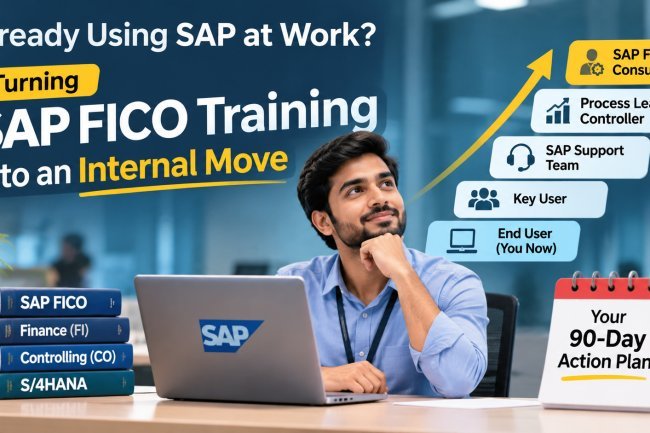
This is the step people want to skip, and it is the one that matters most. Very few companies hire someone with no work experience straight into a full SAP FICO consultant role. The realistic first roles are:
- SAP FICO end user or finance executive in a company that runs SAP
- SAP support analyst, handling tickets from users
- Junior or trainee consultant in a consulting firm
Each one gives you what a course cannot, and what every SAP FICO consultant interview checks: real users, real data and real deadlines. Even the search for SAP FICO consultant jobs for freshers goes better once you can say you have handled live month-end work.
AtZeblearn, placement support covers resume and LinkedIn help, mock interviews and interview referrals. It is support, not a job guarantee, so your practice and interviews still decide the outcome.
What to show before moving on: a year or more of handling real tickets or finance work in SAP, including at least a few month-end closes.
Stage 4: Get on a real project
Projects are where you start to think like an SAP FICO consultant, because you see how SAP is built for a business, not just how it is used. Look for a chance to join an implementation, a rollout to a new country or plant, or an S/4HANA migration. Offer to help with testing first.
On a project, you also start working with people from other areas. Custom reports and forms are built by developers, so it helps to know enough about SAP ABAP training topics to explain what you need clearly.
System access, transports and performance issues sit with the technical team. A basic idea of what SAP Basis training covers will help you understand why your change needs a transport and when it can move to the live system.
Payroll is where finance and HR meet. Salary postings flow from HR into FI, so you may work with people trained through an SAP HCM course on how those postings are mapped.
Companies with cloud HR often use SuccessFactors instead. Payroll results still need to reach FI, and the SAP SuccessFactors training side of the team owns that link with you.
In manufacturing companies, CO depends heavily on production. Product costing uses data from production orders, so the people behind SAP PP training become your daily partners.
Quality checks affect finance too. Stock held for inspection is not yet free for use, which is where SAP QM training knowledge meets your work.
Newer projects add apps and automation on top of S/4HANA through the Business Technology Platform, and a basic view of what SAP BTP training covers will help you follow those discussions.
What to show before moving on: at least one named project, your exact role in it and the settings or processes you were responsible for.
Stage 5: Become an SAP FICO consultant
By now, the jump is a natural next step, not a leap. You already have system experience, project stories and a feel for how finance connects with other modules.
Certification helps at this point, especially if you want to move to a consulting firm or work abroad. SAP offers the Financial Accounting exam (C_TS4FI), a 3-hour exam with a 60% pass score, and the Management Accounting exam (C_TS4CO), with a 59% pass score. Exams are booked through SAP Learning, and the fee is paid to SAP.
What really sets you apart, though, is how you talk about your work. A strong SAP FICO consultant can explain a requirement, the options, the choice they made and why. Practise telling two or three project stories in that order.
What to show: certification, two or three clear project stories and the ability to handle a finance user’s question calmly.
Your realistic plan for how to become an SAP FICO consultant
The path is longer than most ads suggest, but it is clear. To become an SAP FICO consultant, learn the foundations, practise until you can explain everything, take a first SAP role, earn a project and then step into consulting. Each stage builds proof that the next stage needs.
Two shortcuts slow people down: applying only for senior roles straight after a course, and listing projects you cannot explain. Avoid both.
If you are at stage one and want to know which batch or learning route suits your background, you can talk to aZeblearn counsellor before you start.
Related FAQs
How to become an SAP FICO consultant from zero?
Go through five stages: learn FI and CO, practise a full project, take a first SAP role, join a real project and then move into consulting.
Can a fresher become an SAP FICO consultant directly?
It is rare. Most freshers start as end users, support analysts or trainee consultants, and build project experience before taking a full consultant role.
Do I need an accounting background to become an SAP FICO consultant?
Yes, basic accounting helps a lot. You should understand journal entries, accruals, depreciation and the trial balance before learning SAP FICO.
Is SAP certification required to become an SAP FICO consultant?
It is not always required, but it helps when you apply to consulting firms or jobs abroad. Project experience still matters more.
Which other SAP modules should an SAP FICO consultant understand?
Mainly MM for purchasing, SD for sales and PP for production costing. A basic idea of HCM payroll postings also helps.
Does Zeblearn help with the first SAP job after training?
Zeblearn offers placement support with resume and LinkedIn help, mock interviews and interview referrals. It is support, not a job guarantee.