About the Course
What Is OData in SAP?
OData, short for Open Data Protocol, is a standard way to read and change business data over the web. A Fiori app on a phone does not open tables in S/4HANA directly. It sends a web request, such as "give me open sales orders for customer 1001", and an OData service answers with clean data in JSON or XML.
In the SAP world, that service usually runs through SAP Gateway. You define the data model, write the logic in ABAP or expose it from CDS views, and publish it so apps can call it. Almost every Fiori screen you will ever touch sits on top of one of these services, which is why the skill is in steady demand.
The Project: A Sales App for a Pune Auto-Parts Distributor
Imagine a parts distributor in Pune whose field sales team keeps phoning the office to ask about stock. The company wants a simple Fiori app instead. You build the service behind it. First you model two entity sets, sales order headers and items, with an association between them. Then you code the read so a rep can filter orders by customer and page through results. Next you add a deep insert, so one call creates an order with all its lines. A batch request lets the app send several changes at once. Finally you secure the service, test every call in the Gateway Client and in Postman, and rebuild the read side as a CDS-based service to compare the two ways.
OData Words Explained Simply
| Term | What It Means |
|---|
| Entity type and entity set | The shape of one record, and the list of those records |
| $metadata | A document that describes everything the service offers |
| SEGW | The Gateway Service Builder, where classic services are modelled |
| MPC and DPC classes | Generated ABAP classes for the model and for the data logic |
| Deep insert | Creating a header and its items in one request |
| CSRF token | A safety value the app must send before it can change data |
What You Learn in SAP OData Training
SAP OData training at Zeblearn follows the order in which a real service gets built, from the idea of a REST API to a secure service that a live app depends on.
Foundations and Gateway
You start with web services in plain terms: REST vs SOAP, HTTP methods and the difference between OData V2 and V4. Then you look at Gateway itself, how a service is registered with /IWFND/MAINT_SERVICE, and how to test calls in the Gateway Client.
Building and Coding Services
Most class time goes here. In SEGW you create projects, entity sets and associations, then redefine methods in the DPC extension class. You write GET, POST, PUT and DELETE logic, and add filtering, sorting, paging, $expand, batch calls and deep inserts. You also learn how to raise clear errors and keep reads fast by pushing work to the database.
CDS, Security and Real Use
Later weeks show the newer route: exposing CDS views as services and, on S/4HANA, the RAP model with a service definition and binding. You add authorisation checks, see how OAuth 2.0 and CSRF tokens protect a service, and connect your work to Fiori, BTP and the Integration Suite.
SEGW or CDS: Which Should You Learn?
Learn both, in that order. Thousands of running systems still use SEGW services, and support jobs expect you to read and fix them. New development on S/4HANA leans towards CDS views and RAP, where much of the plumbing is generated for you. Knowing SEGW first makes the generated parts easier to understand.
If you want to go further into the modern model after this course, our RESTful application programming course on BTP builds on what you learn here.
Week by Week
| Week | Focus |
|---|
| 1 | REST, HTTP methods, OData V2 and V4 |
| 2 | Gateway setup, service registration and testing |
| 3 | SEGW projects, entity sets and associations |
| 4 | Read logic, filters, sorting and paging |
| 5 | Create, update, delete and batch calls |
| 6 | Errors, performance and services built from views |
| 7 | Security, CSRF tokens and OAuth basics |
| 8 | Fiori link, the Pune project and interview practice |
Is This Online Course Right for You?
SAP OData training is a good fit if you already write some ABAP or have finished a basic ABAP course. The work is coding, so it is not a starting point for complete beginners. If you have never written ABAP, start with our ABAP programming course and come back after it.
It also suits Fiori and UI5 developers who keep waiting on someone else to build their services, and support staff who need to read Gateway error logs with confidence. B.Tech, BCA and MCA graduates with ABAP basics fit well. Classes are live online with a trainer, recorded, on weekday mornings or weekends.
A Tip From Class
Before you write any code, open $metadata and read it like a contract. Most early bugs come from a field name or type that does not match what the app expects.
Course Details and Fees
| Item | Detail |
|---|
| Duration | 8 weeks of 2-hour live classes |
| Modules | 9 |
| Batches | Weekday mornings or weekends |
| Format | Live online, trainer-led, recorded |
| Course fees | ₹75,000, EMI available |
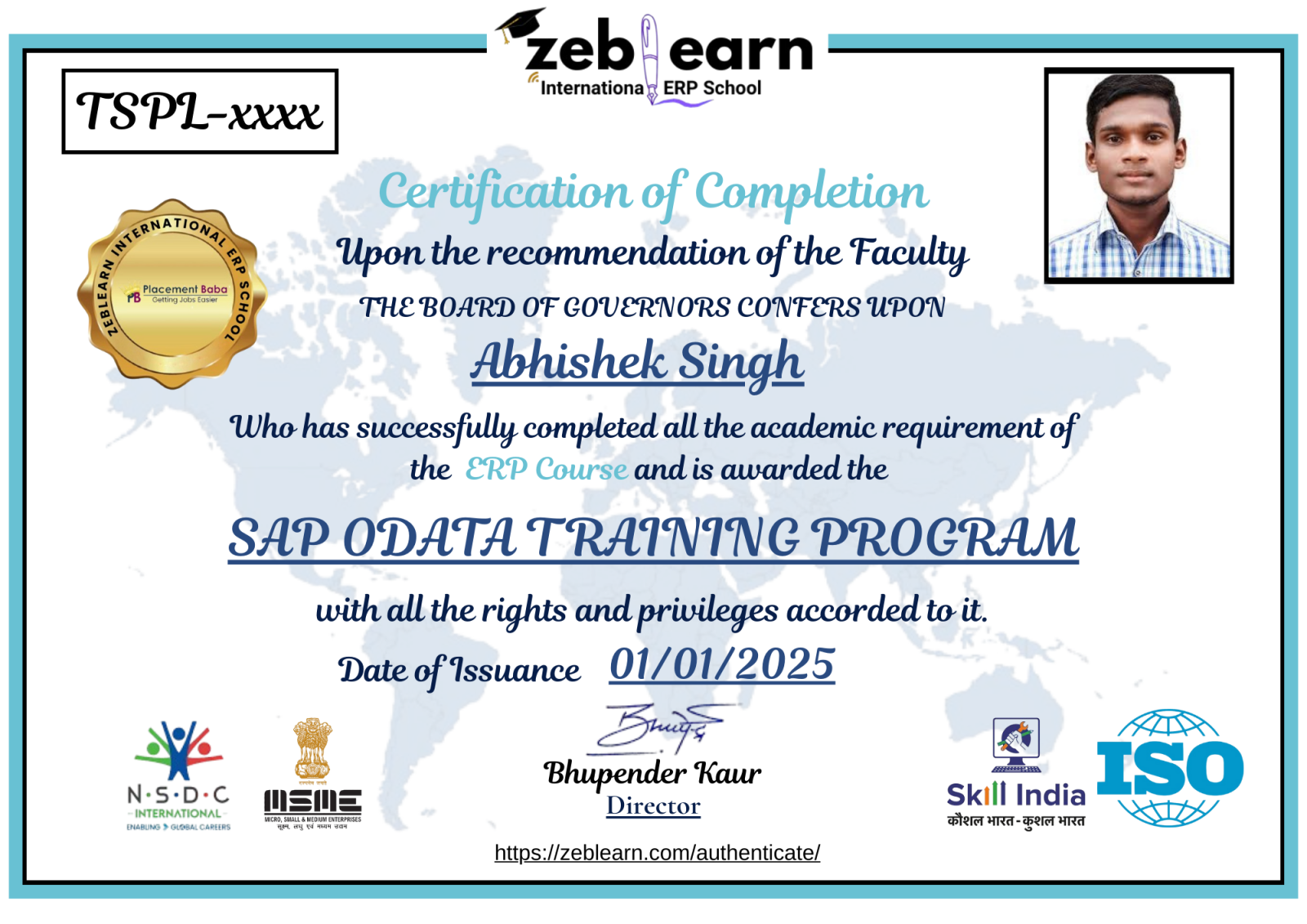
| Certificate | Zeblearn course certificate |
Not sure if your ABAP is strong enough yet? Book a free demo class and judge for yourself.